-
英语语法:将来时的表达方式
关于英语将来时的几种表达法,很多同学在学习时容易混淆。今天小编要说的就是英语中表达将来时的不同方式,主要包括will加动词原形、be going to加动词原形、be doing形式和一般现在时表示将来等几种形式,文中会详细介绍每种用法的具体区别和使用场景。感到兴趣的朋友和小编来了解一下吧

英语将来时的几种表达法是一般将来时和过去将来时。一般将来时表现为will / shall+动词原形, be going to+动词原形, be doing,以及一般现在时;shall / will / be going to +动词原形等。
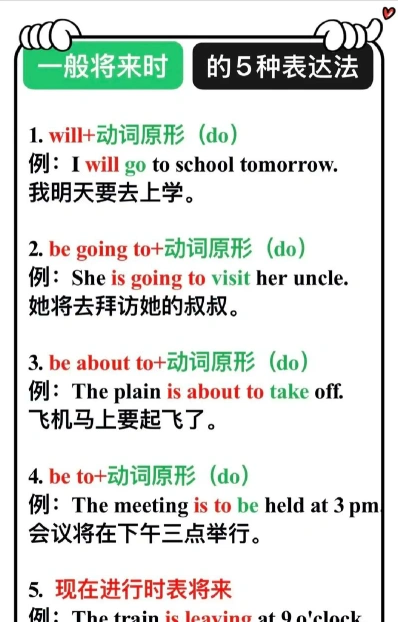
一般将来时态:四种形式表达将来时: will / shall+动词原形, be going to+动词原形, be doing,以及一般现在时.shall / will / be going to +动词原形be to do sth.be +coming (leaving, starting, reaching, returning….)be about to do sth.1. will / shall表示单纯的将来(即现在的之后),will还可以表示”决心”、”意愿”;shall 用于第一、三人称的问句中,还可以表示征求对方的意见.例如:He will be back in a few days.(单纯将来)I will study hard to keep up with my classmates.(决心或意愿)Shall I go with you?(征求意见)注意在含有if的条件状语从句时,主句中要用will表示将来时.例如:If it doesn’t rain tomorrow, we will go climbing.2. be going to+动词原形多用于口语,强调事先的”打算、计划”要做的事情或有某种迹象要发生的事情.例如:What are you going to do this evening?(打算)Look!There are so many clouds in the sky. It’s going to rain, I think. (有迹象要发生的事情)3. be doing代表现在进行时.现在进行时表示即将发生的将来,多与表示位移的动词come, go, arrive, leave, fly, start等连用.例如:She is leaving for Beijing. 她就要启程去北京.4. 一般现在时表示将来时,主要用于时间状语从句或条件状语从句中;或者用来表示按时刻表的规定将要发生的动作.例如:I’ll tell him about it as soon as I see him.My plane takes off at seven tomorrow morning.
过去将来时的表现方式
过去将来时态:(The Future-in-the-Past Tense)1)过去将来时一般由“助动词would(should)+动词原形”构成,也可以用“was (were) going to+动词原形”来表示.过去将来时表示从过去某一时间看将要发生的动作或存在的状态,这种时态常用在宾语从句中.I thought the film was going to be very interesting.我原以为这个电影会很有趣.No one knew which country would hold the next Olympic Games.谁也不知道将由哪个国家举办下一届奥林匹克运动会.2)由were/was going to 表示过去将来时Jackie thought the American country music was going to be very popular. 杰基认为美国乡村音乐将深受欢迎.The Greens were going to spend their winter vacation abroad.格林一家将到国外去度寒假.Zhou Lan said she was going to work hard at her English. 周兰说她将努力学习英语.Charlie wrote he and his father were going to cut rice soon. 查利写道他与他父亲不久就打算割稻.3)用would表示过去将来时They told me that they would come home by air for the holiday. 他们告诉我说他们将乘飞机回家度假.The writer thought it would be wrong to eat monkeys. 作者认为吃猴子肉是不对的.It would be very difficult to make progress if you didn’t work hard.4)过去将来时态中的否定形式The radio broadcast that it was not going to snow tomorrow.电台广播说明天不会下雪.He explained that he was not going to take part in the sports meeting. 他解释说他将不参加运动会.During an earthquake weak buildings would not stay up. 地震时不结实的楼房就要倒塌.He would not prepare any special food for his cousin. 他不给表弟做特别的饭菜.二、用于表示过去未实现的希望和计划的表达:A. should like to / would like to / would love to + 不定式的完成时态B. was / were going to do sth.(用过去将来时态表示原打算做什么.)C. was / were going to have done sth. 表示未完成原来的计划和安排.D. expect , intend , hope , mean , plan , promise , suppose , think , want , wish...常用过去完成时态在这些词后接宾语从句或者接不定式的一般形式;或者用一般过去时态后面接不定式的完成形式表示过去未曾实现的愿望.E. wish that …had done sth.表示过去未曾实现的愿望.F.情态动词should ,would, could, might, ought to等后接不定式的完成时,表示过去本该做,打算做,想做而未做的事情.G. had better / would rather + 不定式的完成时,表示一种过去的愿望.常译为”当初最好/当初真该....”四、现在完成时与一般过去时的区别现在完成时是现在时的范畴,表示过去的动作对现在造成的影响;而一般过去时是过去的范畴,表示过去的动作或现象,与现在无关.例如:He has come here.(说明他现在在这里)He came here.(说明他过去来过这里,但现在是否在这里不知道)
过去完成时had done结构讲解

过去分词。had done用于过去完成时,过去完成时即“过去的过去”,过去已经发生过的事。例句:By the end of last term,we had learned 5000 new words.到上学期末,我们已经学了5000个新词。
had后面用动词过去分词形式,即had done。

had done是过去完成时。表示动作发生在过去的过去。通常句中有过去时间状语作参照。
例句:I had finished my homework before my father came back.
在我父亲回来之前,我已经完成了家庭作业。
had done句型的例句
They had never seen so many of the locusts before.

(他们以前从未见过如此多的蝗虫)
I had reached the station before six o'clock.
(六点之前我已到达车站。)
Fortunately, the population had left the village before the volcano erupted.
(幸运的是,火山喷发前人们已离开了村庄。)